
In today's digitally oriented era, more and more organizations are turning to cloud technologies to improve efficiency, increase flexibility and support innovation. Migrating to the cloud, however, can be a complex process that requires thorough planning and strategic decisions. In this post we look at the possibilities of cloud migration, focusing on the three primary approaches: rehosting (lift and shift), replatforming and refactoring.
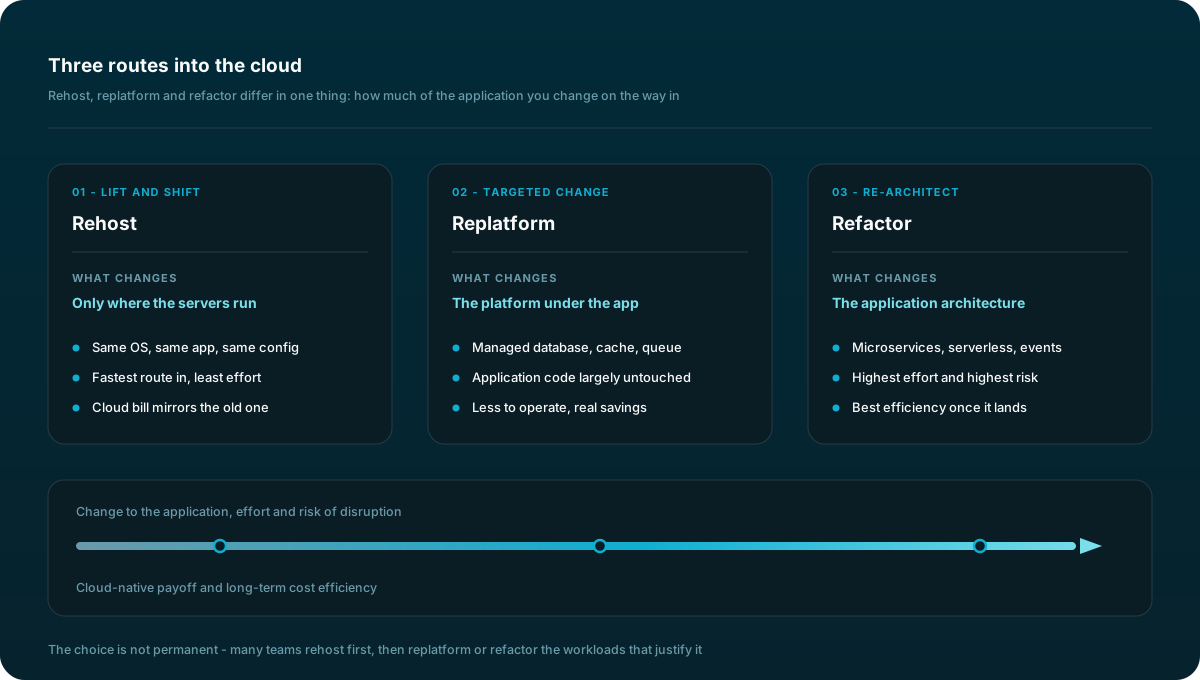
Rehost (lift and shift)
Rehosting, commonly known as "lift and shift", is the most straightforward approach to cloud migration. The method involves moving your existing virtual servers and their applications into a cloud environment with minimal or no changes. It is the equivalent of picking up your data center's infrastructure and dropping it into the cloud.
Advantages
- Speed: It is the fastest way to migrate to the cloud, because it involves minimal changes to your applications and infrastructure.
- Simplicity: Since the method requires no significant modifications, it is relatively easy to implement.
Disadvantages
- Cost: It may look cost-effective at first, but rehosting can lead to higher operational costs in the long run, because you are probably not taking full advantage of the cost efficiencies of cloud-native features.
- Limited optimization: Since the applications are not optimized for the cloud, you may not reach optimal performance and scalability.
Replatform
Replatforming involves a bit more than just lifting and shifting. In this approach you make some adjustments to your applications so they use the cloud environment better, but without a complete overhaul. That might mean adopting cloud-managed services such as database services, caching services or queuing services to improve performance and scalability.
Advantages
- Cost efficiency: By using managed services you can reduce operational costs and take advantage of the pricing models of cloud services.
- Improved performance: Adjusting your applications to use cloud-native features can lead to better performance and scalability.
Disadvantages
- Moderate complexity: Replatforming requires more effort and planning than rehosting, because it involves making changes to your applications.
- Risk of downtime: If it is not managed carefully, the transition can lead to downtime or performance problems during the migration.
Refactor
Refactoring is the most comprehensive approach to cloud migration. It involves re-architecting and often rewriting parts of your applications so they fully embrace cloud-native technologies and architectures such as microservices.
Advantages
- Optimal efficiency: By redesigning your applications for the cloud you can reach the highest levels of efficiency, performance and scalability.
- Cost savings in the long run: It requires a higher initial investment, but refactoring can lead to significant cost savings over time thanks to the efficient use of cloud resources.
Disadvantages
- High complexity: This approach requires a significant amount of effort, expertise and resources. It is the most demanding and time-consuming migration strategy.
- Risk: Refactoring carries the highest risk of disruption, because it involves significant changes to your application's architecture.
The three approaches side by side
| Strategy | Speed | Effort and complexity | Cost over time | Risk of disruption |
|---|---|---|---|---|
| Rehost | Fastest | Lowest, no significant changes | Cheap up front, higher to operate long term | Lowest |
| Replatform | Medium | Moderate, targeted changes to the application | Lower, managed services take over the operational load | Moderate, downtime if the cutover is not managed carefully |
| Refactor | Slowest | Highest, needs expertise and resources | Higher up front, the largest savings over time | Highest, the architecture itself changes |
The path to cloud migration is not one-size-fits-all. The choice between rehosting, replatforming and refactoring depends on your organization's specific needs, goals and constraints. Rehosting offers a quick and simple way to move to the cloud, while replatforming and refactoring open up opportunities for greater optimization and efficiency.